It did. I saw it. You know, it would seem to me that timing really isn't the issue as much as the xmtr frequency being exact at all three sites. Although, on FM, the frequency is modulated at the same rate in the overlap areas, so I can see where timing is critical, but unless all 3 xmtrs are synched to the same frequency, it's still gonna sound like a jumbled mess... The answer isn't simple, but it looks like you're either going to have to reduce transmit power output or incorporate low-gain directional antennas for the transmitters. Lower gain transmit antennas a few (hundred?) feet down from the RX antennas? Just tossing some thoughts out there. Good Luck, Jeff. On Feb 15, 2018 12:53 PM, "Jeff Carrier" <k0jsc.jeff@gmail.com> wrote: ...I'm not sure that mailman passed the image. If you're interested I can send it off list. On Thu, Feb 15, 2018 at 11:50 AM, Jeff Carrier <k0jsc.jeff@gmail.com> wrote:
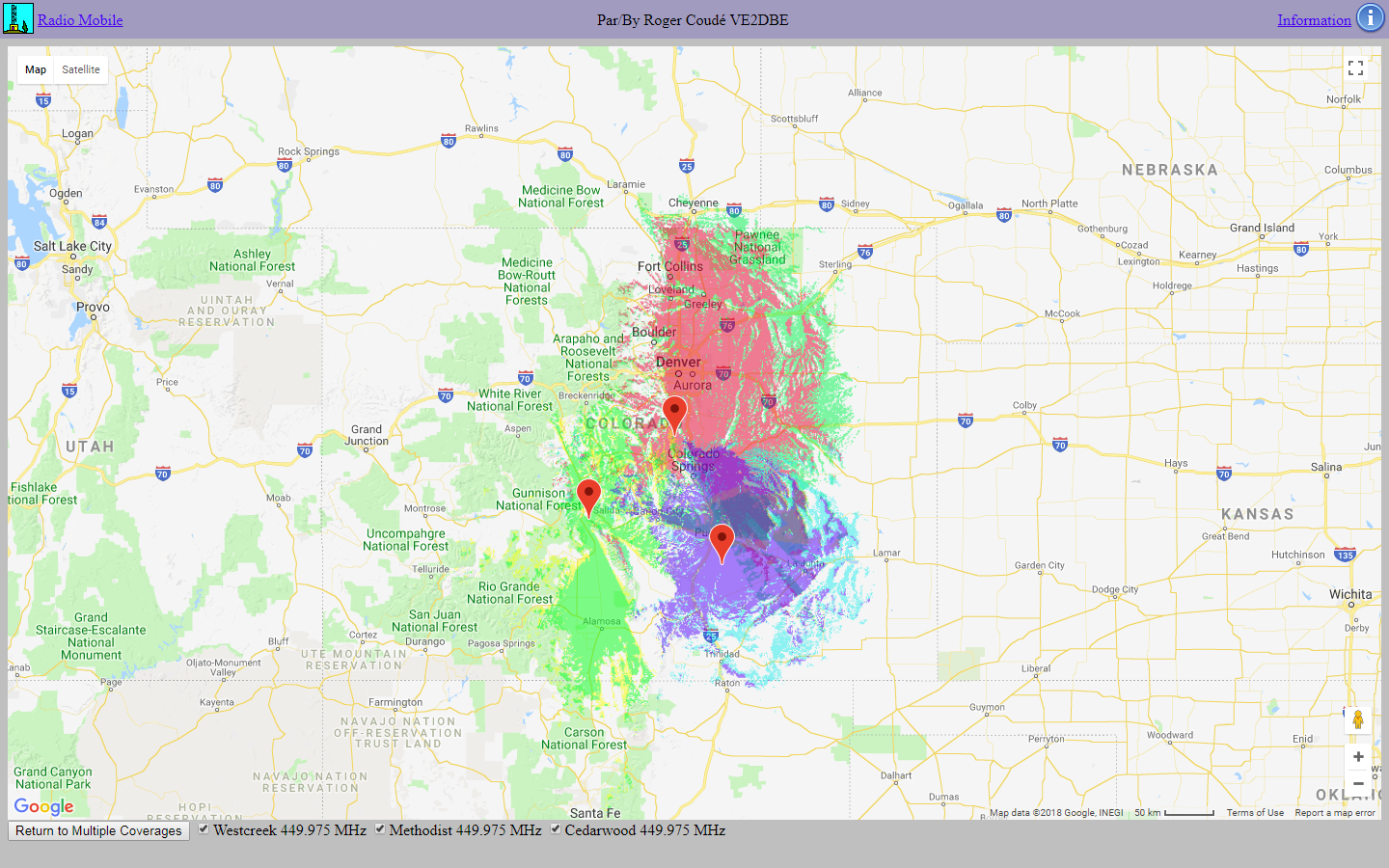
Here's a down and dirty display of overlap with transmitter power, feed line loss, antenna gain, pattern and azimuth figured in.
[image: Inline image 1]
Message: 8 Date: Wed, 14 Feb 2018 17:33:50 -0800 From: Tim Sawyer <tisawyer@gmail.com> To: Users of Asterisk app_rpt <app_rpt-users@lists.allstarlink.org> Subject: Re: [App_rpt-users] Simulcast buffer value issue Message-ID: <CAG3ht9t7Unky+Tc0MFTOLg2Z3+pcnoWFM2AyNFKeFcrOeE4cdw@mail.gm ail.com> Content-Type: text/plain; charset="utf-8"
11,000 feet! No way that will simulcast well, not at 70 miles.
On Tue, Feb 13, 2018 at 8:10 PM, Jeff Carrier <k0jsc.jeff@gmail.com> wrote:
I really hope to be able to confirm this soon. I've been lazy and our 3 sites are 86 miles, 79 miles and 70 miles (in a triangle). One of the 3 is over 11,000 feet elevation. No matter what we've tried so far you still hear distortion in the overlap area(s) even when 1 site is 20 miles out LoS and the other is around 60 miles out non LoS. Everything is linked on a private uW network with very low latency and basically zero packet loss. The transmitters (GE MIII) run about 1hz freq error with the gpsdo attached.
Sometimes I just wonder if this is just multi-path from the various granite reflectors we have on the front range of Colorado (one of them is Pikes Peak)
de K0JSC
------------------------------
Message: 6 Date: Tue, 13 Feb 2018 20:43:42 +1100 From: Hayden Honeywood <haydenph91@gmail.com> To: app_rpt-users@lists.allstarlink.org Subject: [App_rpt-users] Simulcast buffer value issue Message-ID: <CAC0VLD0-9mc=T8BkvMwx6PqWXqtUXCYY2odbjc2ajjDiVLKSBg@mail.gm ail.com> Content-Type: text/plain; charset="utf-8"
Interesting thoughts Tim... perhaps worth documenting on the wiki? Even though it was just "in theory", what kind of sync error was it? Were we talking microseconds or even more?
I have a receiver on a yagi pointed at a distant simulcasted site. I have noticed on occasion, I can hear the distant simulcasted site start to send audio underneath the carrier of the site that is closest (and strongest to me). The distant site is also the master site, and has the lowest latency, but I'm talking two words worth of audio is send before my other site starts sending audio. Once they are both transmitting, I have not noticed any timing issues (i.e. distortion etc). I'm not sure if this issue was related to what I posted previously about the variable audio delay on unkey.
I'm running app_rpt on a Raspberry Pi using a cut down image we use
here
in VK.
"When simulcasting the audio from all (non captured) transmitters needs to arrive at the receiver with in an acceptable time frame (80 us). The DAC theory was that it didn't start sending audio at correct clock cycle every time. That would cause the audio to be out of sync between RTCMs causing simulcast distortion.
As I said, that was the theory. The new theory is that the external clock source was causing the DAC to trigger inappropriately. I spoke with someone I met here on the list (Kevin I think its was) who is using a different external clock and reports perfect simulcast operations"